The best airport transfer is the one that gets you to your actual accommodation with a manageable amount of effort. A fast train to a central station can be a poor choice if it leaves you with an awkward connection and heavy luggage. A slower direct bus can be a better arrival plan when its stop is close to your destination.
Start with three facts: your arrival terminal, the time you expect to leave the airport, and your accommodation's full address. Then compare the complete journeys available at that time. This guide explains how to make that comparison, what to verify with official operators, and how to prepare a backup without turning your arrival into a research project.
Start with your accommodation, not a generic city-center stop
Save the full street address and the correct entrance before you travel. A hotel name alone can be ambiguous, especially when several properties share a brand. Look at the destination on a street map and identify the nearest useful station or bus stop. The closest stop is not always the simplest: a slightly longer walk may avoid a difficult interchange.
Check how the last part of the trip works with your luggage and access needs. Look for major roads, steep streets, long passages, and station exits that emerge on different sides of an intersection. If the accommodation offers arrival instructions, compare them with the operator's planner. Write the destination in the local format where helpful so you can show it to a driver without relying on mobile data.
Estimate when you will actually be ready to leave
Your flight's scheduled landing time is not your departure time from the airport. You may still need to reach the arrivals hall, complete any applicable arrival processes, collect bags, use a restroom, and find the transport departure point. Leave flexibility instead of purchasing a narrowly timed connection based only on the published flight arrival.
Research the timetable for the day and approximate departure period you need. Weekend service, engineering work, holidays, and late-night gaps can change an otherwise straightforward route. Check whether the last useful departure is the last train from the airport or the last connection onward to your neighborhood. A route that reaches the central station after local transport stops may leave a substantial final expense.
Compare rail services by where they go
Airport rail can include an express service, an ordinary suburban train, and a metro connection with different stopping patterns. Compare the station you need, the number of changes, and the ticket conditions rather than assuming that the product with express in its name is automatically the best option.
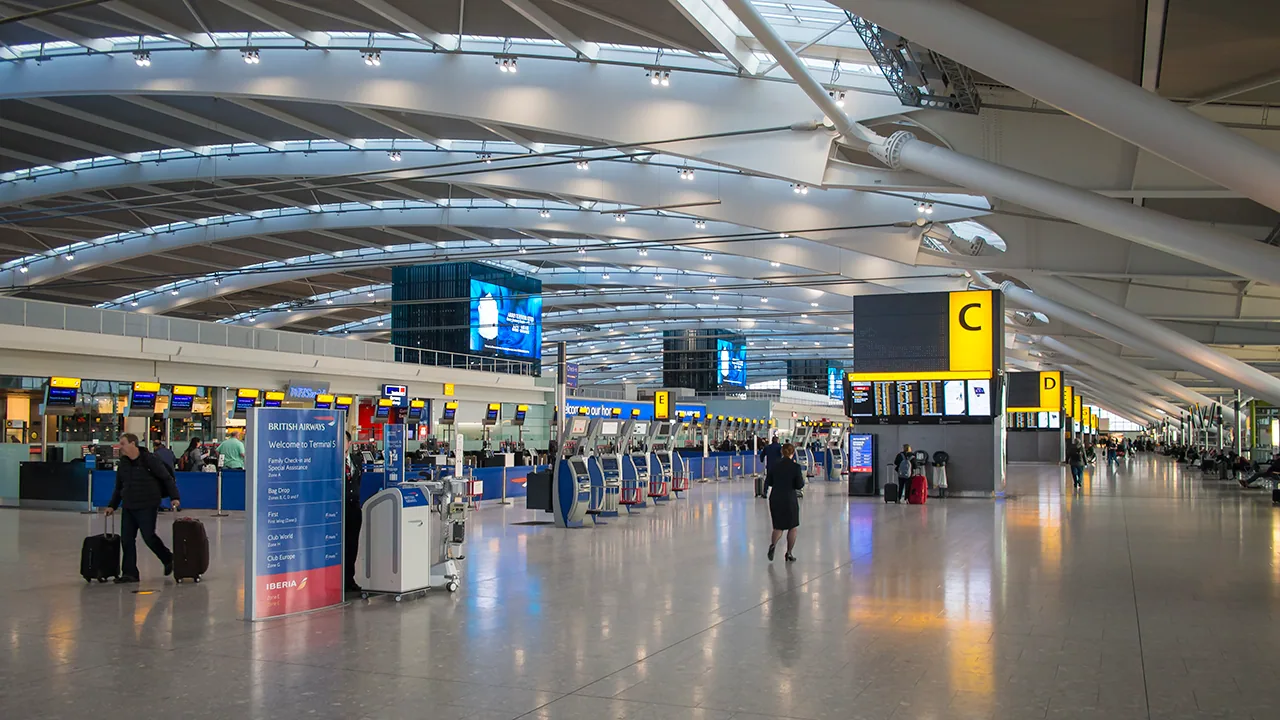
Heathrow illustrates the distinction. The airport describes Heathrow Express as a non-stop connection to Paddington, while the Elizabeth line serves several central London stations and the Piccadilly line is another rail option. The useful choice changes with your endpoint. Consult Heathrow's current transfer guidance and TfL's planner rather than treating central London as one destination. For a stay near an Elizabeth line station, avoiding an extra connection may matter more than the fastest airport-to-terminal-station headline.
Official references: Heathrow: travelling to and from the airport FAQs · TfL: getting to and from Heathrow on the Elizabeth line
Assess buses, taxis, and prebooked vehicles fairly
A scheduled airport bus can be convenient when it serves your neighborhood directly, but check which terminal it uses and whether luggage space is available. A shared shuttle may include intermediate drop-offs. A private vehicle can simplify the journey for a group, although the collection point may still require a walk through the airport.
When comparing a taxi or booked transfer, establish what the quote includes: airport collection charges, waiting arrangements, luggage capacity, child-seat needs, and any late-arrival conditions. Use the airport's official taxi information or a provider you can independently identify. Do not assume that an advertised from price is the amount for your journey. Traffic variability also matters, particularly when you are planning the return trip to a flight.
Make a door-to-door comparison
Create a small comparison with four columns: complete route, total likely cost for your party, practical effort, and backup. Include the walk to the platform, any transfers, the final approach to the accommodation, and realistic waiting. You do not need a perfectly accurate minute estimate; you need to see which route contains fragile or uncomfortable parts.
For a hypothetical example, imagine two adults arriving with a suitcase each. Route A has one train and a long final walk. Route B needs a change but stops near the hotel. Route C is a direct car. If one traveler cannot manage the final walk, Route A is unsuitable regardless of its low fare. If both are comfortable walking and arrive in daylight, it may become the preferred choice. These are planning assumptions, not claims about a particular airport.
Check terminal access and the entire accessible route
An airport train station can be connected directly to some terminals and reached by an internal transfer from others. CTA's airport guide, for example, distinguishes the connection between O'Hare's Blue Line station and different terminals. Sound Transit's Seattle airport guidance explains the approach to SeaTac/Airport Station through the airport complex. Follow the current official directions for your terminal rather than an old screenshot.
For an accessible journey, verify the route from the arrivals hall to the vehicle, through any interchange, and from the destination stop to the accommodation. Step-free access to a platform does not always describe the gap between the platform and train. Ask the operator about assistance when needed, and check live elevator information where available. Luggage, a stroller, or fatigue can also make this detail relevant even without a mobility device.
Official references: CTA: trains to O'Hare and Midway airports · Sound Transit: Seattle-Tacoma International Airport · TfL: plan an accessible journey
Prepare payment and a small offline arrival pack
Confirm whether your chosen service accepts a contactless bank card, requires a transport ticket, or uses a reservation. An airport rail ticket may not cover the connecting city bus or metro. Check each operator's conditions and whether any airport supplement applies before deciding that a city pass covers the entire trip.
Save the route, destination address, departure location, operator link, and backup in a note you can open offline. Keep a payment option accessible instead of packing it deep in a suitcase. Download only the apps that solve a real part of the journey. If your main ticket depends on a phone, ensure you can display it throughout the trip and understand the provider's recovery process if the device fails.
Plan one backup and research the return separately
A useful backup is specific enough to act on. Know the alternative operator, where it departs, and how payment works. That might mean an official taxi rank after a missed rail connection, or a different scheduled service if the preferred line has planned work. Keep any reservation's delay and cancellation terms with the booking.
For departure day, reverse the full journey and work backward from the airport's guidance and your airline's requirements. Morning service may differ from afternoon service. A direct arrival connection may not run at the time you need to leave. Avoid adding an ambitious final sightseeing stop before an unfamiliar airport transfer. Protect the flight rather than designing the most efficient-looking itinerary on paper.
Coordinate the plan for everyone arriving together
When several people are arriving together, agree on one meeting point and one person who will check the route. Separate decisions about money, transport, and the destination before you leave home. A family can otherwise arrive with one person expecting a reserved car, another expecting rail, and no shared understanding of where to meet after collecting bags.
If travelers arrive on different flights, avoid a tightly timed shared reservation until you understand the provider's waiting terms. Compare meeting at the accommodation with waiting at the airport. Keep the accommodation address and the chosen fallback available to every adult rather than on one phone alone. A shared plan should still work if a device is unavailable or someone needs extra time. Simplicity at this stage often matters more than a small theoretical saving.
Avoid the mistakes that make arrivals harder
The most common planning error is comparing only advertised ride times. Others include confusing airports with similar names, choosing the wrong terminal stop, ignoring luggage restrictions, and buying a pass before checking airport coverage. A transfer booked for the whole group can also become unsuitable if the vehicle's luggage allowance is smaller than expected.
Before departure, ask one final question: could you follow this plan while tired, offline, and carrying your actual bags? If the answer is no, simplify it. Reduce the number of decisions between the arrivals hall and your accommodation. Keep a short instruction sequence, verify current service information, and leave your first city afternoon flexible enough to absorb a slower arrival.
Frequently asked questions
Should I book an airport transfer before I fly?
Book ahead when the service requires a reservation, your arrival needs special arrangements, or a clear confirmed pickup reduces uncertainty. For frequent public transport, check whether a reservation is necessary before committing to a restricted ticket. Compare delay terms and the complete destination journey first.
Is the airport train always better than a taxi?
No. Rail can avoid road traffic and suit a connected destination, while a direct vehicle may reduce transfers for a group or travelers with specific access needs. Judge the whole route, collection point, baggage, and current total cost rather than the vehicle type alone.
Can a city transport pass cover the airport journey?
Sometimes, but coverage is product-specific. Airport supplements, express services, zones, and different operators can sit outside a pass. Verify the exact service and both ends of the trip on the operator's official fare page before relying on the pass.
Sources & further reading
- Heathrow: travelling to and from the airport FAQs ↗
- TfL: getting to and from Heathrow on the Elizabeth line ↗
- CTA: trains to O'Hare and Midway airports ↗
- Sound Transit: Seattle-Tacoma International Airport ↗
- TfL: plan an accessible journey ↗
Source review: October 22, 2026. Opening arrangements, prices, access, and services can change; confirm current details with the responsible operator.
Editorial note
This guide is an editorial synthesis of referenced information and practical planning advice. It does not claim first-hand visits or live operator information. Hypothetical examples are identified in the text.
How we review content · Suggest a correction
Back to Getting Around